
If you run a small business in 2026, you have probably heard the same advice more times that you can count.
You need to be on social media.
You need to run Google Ads.
You need SEO.
You should start making videos.
You should use AI.
And now there are even more terms to keep up with. AI Search. Google AI Overviews. Automation. AEO. GEO. and the list keeps getting longer.
The problem isn’t a lack of marketing advice. The problem is that a small business doesn’t have unlimited time, money or people to manage all of it at once.
So instead of giving you another list of digital marketing channels to add to your to-do list, I want to start with a simpler question:
What actually needs fixing right now?
After working across performance marketing, SEO and content, I keep coming back to four questions:
Can people find you?
Do they understand what you offer?
Do they trust you?
Is it easy for them to act?
I call this the Find → Understand → Trust → Act framework.
Digital marketing for small businesses in 2026 can be simple if you focus on what really matters without getting distracted by every new platform, or trend.
What Does Digital Marketing Actually Mean For a Small Business?
Before moving straight to strategy, let’s first understand what digital marketing covers for a small business.
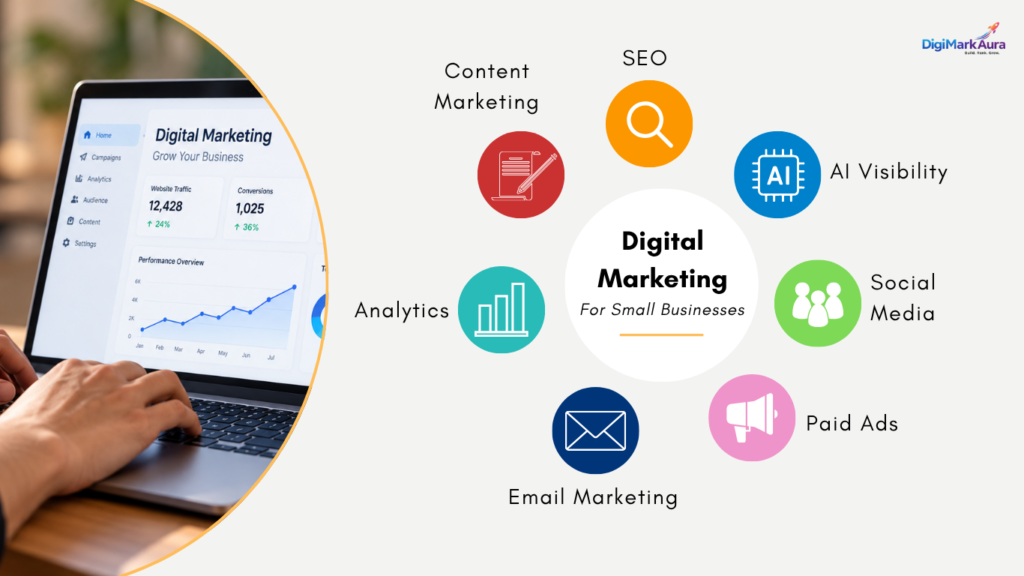
Digital Marketing for small businesses is the use of online channels and activities to help potential customers find out about your business, understand what you offer, and decide whether to do business with you.
That can include:
- Your website
- Search engine optimization (SEO)
- Local SEO
- Content marketing
- Social media
- Paid advertising
- Email marketing
- Online reviews
- Analytics and conversion tracking
- Visibility across AI tools such as ChatGPT, Gemini, and Google AI’s Overviews
The important part is that you don’t necessarily need all of these at the same time.
A local service business may get more value from local SEO, a strong Google Business Profile and a website that converts visitors into enquiries.
A B2B company may need a different mix of SEO, LinkedIn, content and lead generation.
An e-commerce business may have completely different priorities around product pages, shopping ads and paid advertising.
The right digital marketing strategy for a small business starts with the customer and business problem, not with a list of channels.
Why Does Digital Marketing Matter for Small Businesses in 2026?
A lot of small business marketing advice starts with a list of channels.
“Try SEO”
“Run ads”
“Post on Instagram”
“Start a blog”
But the most important question is:
Where are you actually losing potential customers?
Imagine two businesses:
The first one has a visually impressive website, but zero online visibility.
The second gets plenty of visitors, but the website doesn’t explain what the business does or how to contact it.
Both of them have completely different problems. Sending more traffic to the second business won’t necessarily solve anything.
That’s why I look at digital marketing in four stages:
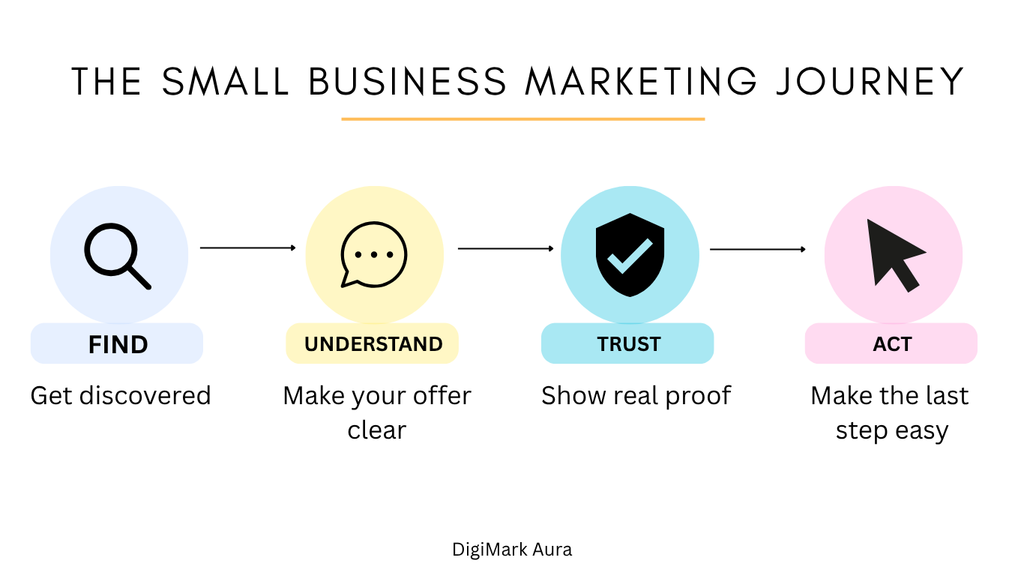
- Find: Can potential customers find your business? This stage consists of digital marketing activities such as SEO, local SEO, Google Business Profile, relevant content, and paid advertising.
- Understand: Once they land on your website, can people understand what you offer, who it is for, and where you work? This stage depends on how clearly you mentioned every detail in the website, including service pages and messaging.
- Trust: Why would someone choose your business over someone? Customers trust when they see reviews. Your expertise in a particular industry, how honestly you are communicating with them and whether you have mentioned the same details about your business in every platform.
- Act: Once someone is interested in your business, is the next step clear? The last step is one of the most important parts of the customer journey and it should be clear and simple to follow. It depends on how easily they can contact you, or schedule a meeting with you, or buy a product from the website directly.
Find: Can People Actually Discover Your Business?
Before someone can become a customer, they need to find you.
Search is still an important part of the process, but the ways people are search for information are expanding.
Someone might search on Google:
“top cafes in Dehradun”
They might search Google Maps.
They might find out about your business through Instagram.
They might have landed on your website through ads.
They may also have used AI-powered search experience to ask about your business.
Google’s May 2026 guidance for AI Overviews in Search focuses on the foundational SEO practices used for Search remain important for AI Overviews and AI Mode. There is not a separate set of technical requirements that businesses need to follow just to appear in these AI features.
This means businesses don’t need to throw away SEO fundamentals they have already been building but, to make your website and business information clear, useful, and valuable to your customers.
SEO for Small Businesses: Focus on Search Intent, Not Keyword Density
You may have heard many times:
“Find the right keywords and add them on your website.”
It’s true keywords still matter because they help you understand what people are searching for. But effective SEO is about much more than repeating a phrase on a page.
Imagine you are an interior designer.
Someone searches for “interior designer”. That’s a broad term with no clear intent. Now compare it with “interior designer for 4BHK house in Dehradun”. That second search gives you much more information. You know the person is probably looking for: interior design, specific property type, and specific location. And, that’s what we call a search intent.
A useful small business SEO strategy should focus on questions such as:
- What are customers actually searching for?
- Which services are they looking for?
- What information do they need before contacting you?
- Which locations do you serve?
- What questions do customers repeatedly ask?
- What makes your business different?
Your website should answer all the above questions through specific service pages, FAQs, guides and other pages that are necessary.
Local SEO: An Important Opportunity for Local Businesses
If customers visit your shop, office, clinic, restaurant or service area, local SEO deserves attention.
Start with creating your Google Business Profile. Make sure your:
- Business name
- Category
- Address or service area
- Phone Number
- Website
- Opening hours
- Services
- Photos
are accurate and up to date.
Your Google Business Profile is not just another checkbox, it is an important part of your local online presence. Therefore, remember to keep the information accurate and updated so that the customers and Google can clearly understand what your business offers, where you work and how to contact you.
Reviews matter too.
Not because review count is a number, but because reviews give potential customers information they can use when comparing unfamiliar businesses. A business with genuine, recent customer reviews builds more trust than a profile with very or zero reviews.
Local SEO in 2026: What to Focus On?
Start with simple things:
- A complete, and updated Google Business Profile
- Reviews from real customers
- Mentioning clearly about the location or service area on the website
- Being consistent about your business details on all the platforms
And don’t think of shortcuts. Fake reviews and keyword stuffing will not build your real local authority. Instead, try to create an online presence that shows the business as it really is.
Understand: Is It Obvious What You Offer and Who It’s For?
This is the stage most small businesses skip entirely and it’s usually the actual bottleneck – not traffic, not rankings, not follower count.
Imagine someone who has never heard of your business landing on your website for the first time. Within a few seconds, can they answer:
- What do you actually offer?
- Who is it for?
- Where are you located, or what area do you serve?
- What makes you different from the other five options they’re also comparing?
If the answer needs scrolling, guessing or clicking through multiple pages, then, you’re losing people who were already interested in your business. Your website doesn’t need to be complicated, it needs to be clear.
A strong homepage should cover up the basic information.
Your service or product pages should go deeper.
And your contact or enquiry process should make the next step simple.
This is important because your website is often the destination where different marketing channels eventually meet. Someone may find you through Google, some may find you through Instagram, or someone visits your website by clicking an ad.
They all eventually need to understand your business.
What Should You Do Next?
One useful test is to open your website as if you were a first-time customer.
Don’t think like the business owner.
Think like someone comparing three or four options.
Ask:
“Would I know what this business does within five seconds?”
Then ask:
“Would I know what to do if I wanted to enquire?”
If either answer is no, fix that before adding another marketing channel.
Content Marketing for Small Businesses: Answer What Customer Actually Ask
Content marketing becomes much more useful when it starts with real customer questions. You don’t need to publish three articles in a week or run a large blog to see results.
Start with your customers. What do they ask before making the purchase? What do they compare? What makes them hesitate? What do they ask you repeatedly? Those questions are your content calendar.
For example, an interior designer could write:
How much does a 3BHK interior cost?
A lighting business could write:
How do I choose the right colour temperature for a bedroom?
A digital marketing agency could write:
How much should a small business spend on Google Ads?
These aren’t random blog topics. They are questions connected to real buying decisions. That gives the content a much clearer purpose.
Google also emphasizes useful, original, people-first content and specifically highlights the value of unique perspectives and first-hand experience.
So before publishing another article, ask:
“What does this page give the reader that they couldn’t get from ten other generic articles?”
That is a much better content question than:
“How many keywords can I put in this article?”
Social Media Marketing: Use It for What It Actually Does Well
For many small businesses, social media is less about immediately closing a sale and more about helping people get to know about your business.
Use it to:
- Show your work.
- Show your services or products.
- Answer questions.
- Share customer experiences.
- Explain things.
- Introduce the people behind the business.
- Show what happens behind the scenes.
And don’t think you need to be active on all the social media platforms.
If Instagram is where your customers spend time, start there.
If you’re a B2B company and LinkedIn is more relevant, your strategy will look different.
If a particular platform consistently produces no meaningful engagement or business value, ask whether the time spent there would be better invested somewhere else. Two well-maintained platforms are often more useful than six neglected profiles.
Trust: Why Would Someone Choose You?
Getting someone on the website is only part of your job. They still need a reason to believe you.
Think about how you personally choose between two unfamiliar businesses. You just don’t look at who has a nicer website, you look for recent online reviews, specific details about what they actually do and other important details. Your customers are doing the exact same thing before contacting your business.
What helps build genuine trust?
- Genuine customer reviews: Latest reviews give potential customers with other people’s opinions about your business. Reply back on the reviews wherever required, including the negative ones.
- Authenticity: “10+ years in business” or “500+ happy customers” will promote trust only if they are true and verifiable. Do not make use of impressive numbers just because they look good on a website.
- Consistency: The story of your business should be consistent across your website, Google Business Profile, and social media profiles. Check basic details such as: business name, contact information, location, opening time, services offered, description. Trust is easier to build when the information is consistent for the customers.
- Visible work – If you sell products, show the products. If you offer a service, show examples of work. If you have a process, explain it. If you have experience, show it.
Buying fake reviews or manipulative backlinks might look like a shortcut, but it actively works against you here. Google’s spam policies specifically address scaled, unoriginal content created primarily to manipulate rankings, including content produced using generative AI without adding value.
Act: Have You Made the Next Step Easy?
This is one of the most overlooked stages of digital marketing for small businesses.
A campaign can generate plenty of clicks and impressions.
A social post can generate views.
A website can generate traffic.
And you can still get very few customers.
The question is not only: “Did people arrive?”
It’s : “What happened after they arrived?”
Before increasing your marketing budget, check:
Is your contact method appropriate?
Some customers prefer phone calls. Some WhatsApp. Others may want a form, booking system or email.
Make the preferred option easy to find.
Is your call to action clear?
Don’t make someone read three paragraphs to discover how to contact you.
Does the landing page match the advertisement?
If an ad promises one thing and the landing page talks about something else, people may leave.
Are you tracking real enquiries?
Clicks and impressions are useful metrics. But if the business goal is leads or sales, you also need to understand what happens after the click. This is where conversion tracking becomes important.
Google Ads or Social Ads for a Small Business?
The answer depends on how your customers make decisions.
Google Ads are useful and show some results in cases where people are already searching for your product or services.
Social advertising can work differently by introducing your business to people who may not currently be searching for it.
Neither is automatically the right choice.
The decision should come down to:
- Customer behaviour
- Search demand
- Competition
- Offer
- Landing page quality
- Customer acquisition economics
- Conversion tracking
And whichever channel you choose, don’t forget the destination. If your website doesn’t convert, increasing advertising spend simply sends more people into the same problem.
Three Things Everyone Tells Small Businesses That Aren’t Always True
“You need to be everywhere online.”
You don’t.
You need to be where your specific customers actually look.
One or two well-maintained channels can be more useful than trying to manage all platforms available.
“Post content constantly to stay visible.”
Not always.
The fact that you are posting your content more often does not automatically mean it is more helpful.
It can be more helpful for a customer or client to have one valuable article rather than several average articles since it solves the customer’s problem.
“AI search means a completely new approach to SEO.”
Not for Google Search.
According to Google’s official May 2026 guidelines, AI-based features work on the same core ranking systems as regular search queries. Business owners do not need to follow every new “AI SEO hack.” The more useful approach is to focus on the fundamentals: technically accessible pages, useful content, clear information, internal linking, and real expertise.
Common Digital Marketing Mistakes Small Businesses Make
1. Trying to be everywhere.
If your customers are using only two social media platforms, then there is no point in having an account in all social media platforms.
2. Chasing followers not customers.
Followers can be valuable, but keep in mind that having followers does not equal revenue.
3. Just posting for the sake of posting.
You can publish as much as you want, but if it is not solving your customer’s questions or providing them something useful, it won’t help.
4. Using AI to create mass content without adding value.
Using AI for researching topics and gathering ideas is not bad, but if it’s replacing your own knowledge and experience then it can create a problem. Content created by AI, a person, or a mix of both, must follow Google’s spam policy.
5. Running ads without tracking conversions.
You may know how many clicks you have, but that doesn’t tell you if the ad campaign is generating any meaningful results for your business.
6. Expecting SEO to work overnight.
SEO takes time because Google needs time to find your website, understand it, and compare it with the websites of your competitors.
7. Using fake reviews or buying backlinks.
Shortcuts can sometimes create more problems in the future.
A Quick Diagnostic: Where’s Your Actual Bottleneck?
Before changing your entire digital marketing strategy, look at what is actually happening.
| What You’re Seeing | Possible Bottleneck | What to Check |
| Nobody is finding you | Find | SEO, local SEO, Google Business Profile, paid advertising |
| Traffic is coming but enquiries are low | Understand / Act | Messaging, offer, CTA, landing page |
| Visitors don’t seem to trust the business | Trust | Reviews, proof, case studies, consistency |
| Ads get clicks but few leads | Act | Landing page, tracking, CTA, offer |
| People enquire but don’t become customers | Trust / Sales Process | Follow-up, qualification, pricing, offer |
| Good traffic and conversions but growth has stalled | Find / Understand | New demand, new services, content, audience expansion |
This is why simply copying another business’s marketing strategy can be a mistake.
Their bottleneck may not be your bottleneck.
How Much Should a Small Business Spend on Digital Marketing in 2026?
There is no universal number that makes sense for every small business.
Your starting budget should depend on your business model, customer acquisition cost, customer lifetime value, competition, current online visibility, sales cycle, and available demand in your category.
Instead of asking:
“How much should I spend on marketing?”
Start with:
“What problem am I trying to solve?”
If your website doesn’t convert, spending more on advertising may not be the first thing to fix.
If your website works well but nobody can find it, visibility may deserve more attention.
If people are finding you but not enquiring, messaging, trust or conversion may be the bigger issue.
Your budget should follow the diagnosis.
A Practical 90-Day Digital Marketing Plan for Small Businesses
If you’re starting from scratch, don’t try to fix everything in the first week.
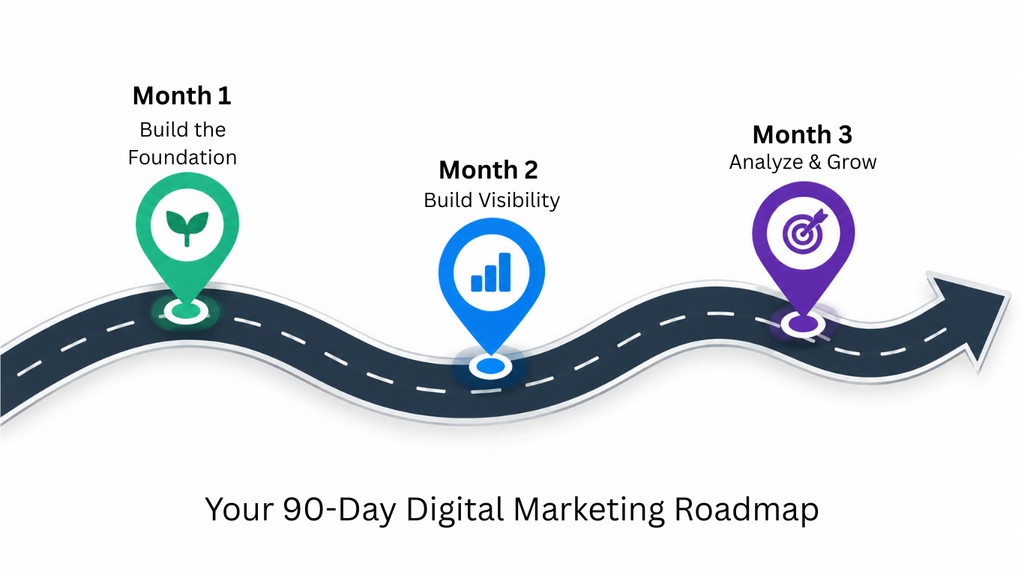
Month 1: Build the foundation.
Start with your website, Google Business Profile, analytics, Search Console, social profiles, main service or product pages, and your contact and enquiry process. Then look at your customers: what are they searching for, what questions keep coming up, and where are you currently losing them? This information will help determine what to prioritize next.
Month 2: Build visibility.
Improve important website pages, work on local SEO, create content based on your real customer questions, build a consistent (not necessarily daily) social presence, collect genuine reviews, and test paid advertising if you’re ready to do so. You don’t need to do all of this at once – pick what matches your current bottleneck.
Month 3: Analyze the results.
Which pages brought relevant visitors? What keywords led people to your site? Did enquiries increase? Which content received organic engagement? You won’t get an answer to all the questions in 90 days, and that’s fine – the goal of the first three months is learning enough to make better decisions about the next three months.
Frequently Asked Questions
1. What’s the best digital marketing strategy for a small business in 2026?
There is not a single approach that works for every small business. You should first start by identifying the main problem: Find, Understand, Trust or Act
If no one knows about your business, work on visibility.
If people are coming but not understanding what you are offering, improve your website and messaging.
If people find it tough to make a decision, build up your trustworthiness.
If people are interested but not making an enquiry, simplify the process.
2. Is SEO still worth it for small businesses in 2026?
Yes, SEO is still relevant.
According to Google’s recommendations for AI Overviews and AI Mode, the basic SEO practices applied in Google Search are still relevant. Google says to concentrate on technical accessibility, internal links, useful content, and people-first content.
However, this does not mean that every business will going to see results quickly through SEO. Results can vary depending on factors such as competition, industry, location, quality of website, and search demand.
3. How much does digital marketing cost for a small business?
There is no single price that works for every business. The cost depends on the services required, the competition, goals, business model, and whether you manage the work yourself or work with an agency. However, it is better to start with defining your biggest marketing problem and how to solve it effectively.
4. Should a small business use Google Ads in 2026?
For Google Ads to be effective, there needs to be search demand for the product or service and the business must have a clear value proposition, and conversion path.
Before allocating additional budgets, ensure that you can measure valuable outcomes, such as lead generation. Just counting clicks does not tell you whether the advertising is actually generating valuable results.
5. Can a small business do digital marketing without an agency?
Yes, many small businesses can manage digital marketing without an agency if they have right skills and enough time. The difficulty usually lies in understanding what to prioritize.
A digital marketing agency can be useful when the need arises for technical SEO, content creation, paid advertising, analytics or optimization while managing the day-to-day operations of a business.
6. How can a small business appear in AI search results?
There are no shortcuts to appearing in AI search results. Google recommends the same basic SEO strategies for AI Overviews and AI Mode that apply to Google Search generally. Make sure your pages can be crawled and indexed, create original and useful content; use internal links; and make important information easy to understand. It also helps to keep your business information accurate and consistent across your website and other relevant online profiles.
7. How long does SEO take for a small business?
There is no fixed timeline. Some changes can produce results quickly, while more competitive keywords can take a significantly longer time. Factors such as your industry, website history, competitors, location, content quality and the keywords you are targeting can all affect how quickly you see progress from SEO.
The important thing is to track progress using meaningful indicators, like impressions, relevant search queries, clicks, enquiries and conversions, rather than expecting instant success on Google.
Final Thought
You don’t need to be everywhere.
You don’t need to publish something everyday.
And you don’t need to chase every new marketing term that appears.
For a small business, digital marketing in 2026 still comes down to the same four things: can customers find you, do they understand you, do they trust you, and can they easily take the next step.
That is the Find → Understand → Trust → Act
Before spending more money on another platform, another campaign or another piece of content, find out which of those four stages is actually holding your business back.
Fix that first. Then move to the next one. That’s a more sustainable way to approach digital marketing for small businesses in 2026.
If you’re not sure which part of your digital marketing needs attention first, contact DigiMark Aura and let’s identify where your biggest gap is.